mETH / mUSD
The live book on Elysium testnet. Every number on this page is read from the chain, and every button writes to it.
Your pieces
Testnet assets
MOSAIC
BUILT ON ELYSIUM
Composable liquidity infrastructure.
Piece by piece, capital finds its place.
The mark
Four tiles, each cracked into tesserae, each pigment carrying a side of the market. The mark is already published; nothing in this sheet redraws it. Everything else is built outward from it.
What the brand has to carry
Mosaic is an on-chain book where a maker position is not an inert order but a tessera: a transferable claim seated at one price tick, which anyone can hold, move, or compose. A market's depth is therefore a literal mosaic — courses of pieces, laid in, taken out, relaid. The identity and the mechanism are the same object, which is why the artwork is allowed to be beautiful and the interface is not allowed to be decorative.
Published key art, measured against

How it works
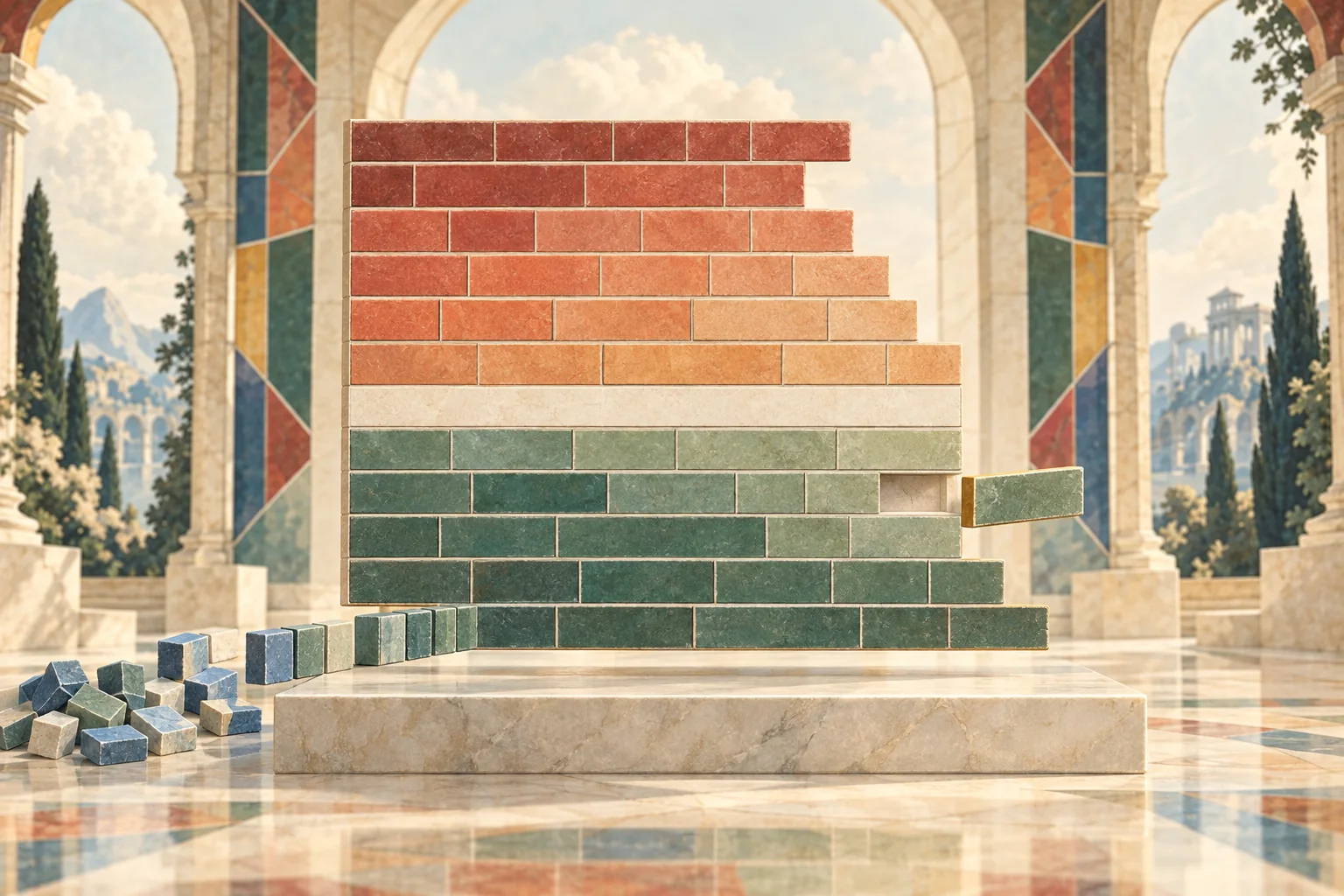
A market is a wall. Prices are its courses. A maker does not send an order into a queue: they seat a piece in a course, and that piece stays an object they own, hold, move, or hand to someone else until a taker consumes it.
Four moves
-
01
Place
You choose a side, a price tick and a size, and deposit the matching asset: quote currency to bid, base asset to ask. In return you receive the piece itself: a token stamped with the market, the tick and the side, which the book will fill alongside everyone else seated there.
-
02
Fill
A taker sweeps from the best price outward, consuming one tick at a time under a bounded
maxTicks. Everyone seated at a consumed tick is filled in the same proportion, whether they arrived first or last. Time priority is replaced by pro-rata, which is what makes the whole book fit in a bounded amount of gas. -
03
Lift
Burn your shares and withdraw what the tick owes you: the part that was filled, in the asset you were paid in, plus the part that was never touched. Lifting is a single call and never depends on anyone else lifting first.
-
04
Compose
Because a piece is a token, it leaves the book without being destroyed: transfer it, post it as collateral, wrap a strategy around it, let a contract hold it on your behalf. A resting quote stops being a dead-end and becomes an asset. That is the whole point of the name.
Pro-rata, not a queue
A queue has to be walked, and walking a queue on-chain is what makes order books expensive.
Mosaic keeps one accumulator per tick instead. When a taker consumes q
at tick t:
filled[t]   += q
acc[t]      += q × 1e18 / shares[t]

owed(piece) = (acc[t] − entry) × piece.shares / 1e18
Seating, filling and lifting are each O(1). A sweep costs one step per tick crossed, not one step per order resting — which is the difference between a book that can live on-chain and one that cannot.
Anatomy of a piece
Two pieces seated at the same tick are filled in the same proportion, whoever arrived first. Pieces at different ticks never mix, which is why the book stays readable as a wall of courses.
Why this chain
Coming next
A Pattern: one call that seats a range of pieces at a chosen spread and step, and reseats each one on the mirror tick after it is filled. A grid market maker, passive, on-chain, owned by the person who placed it.
Pigments
Locked. The semantic shades are darker values of the same pigments, never additional hues.
Allocation across the shell
The depth panel may exceed its colour allowance. The navigation may not. Bid is sage and ask is terracotta in every view, with no exception and no inversion. Ochre means this is your piece / the selected tick — it is never generic success and never decorative gold.
Inscription
The capitals in the key art are Roman inscriptional letters in the Trajan tradition: wide spacing, controlled contrast, ceremonial rather than ornate. Four faces carry the whole system.
Restrictions
tabular-nums lining-nums on every figure.The tessera
The mark's geometry is irregular because it is art. The book's geometry is orthogonal because price and quantity must be measurable. That is a translation of the motif, not its replacement.
The mark
The mark is four tiles, each cracked into tesserae, each pigment holding one role. The version on this
sheet is generated by tools/tesserae.py so the construction is reproducible at any
size; it is recut against the source avatar before anything is minted, signed, or printed.
Construction
The panel
Panels are cut slabs: one pixel of stone, two pixels of radius, no resting shadow. Density comes from rhythm on a 4px unit, not from compression.
Both views read the same ticks. The mosaic answers who holds what, where; the table answers what can I take, now. Hovering a tessera selects its tick in both.
The plates
Painted architecture lives at the perimeter and in editorial surfaces. It never decides where a control goes, and it never sits under a numeral.
Canon
Remove the architecture and the console must still read as Mosaic through its pigments, stone rules, inscription and tessera mechanics. Remove the data and the artwork must still belong beside the published key art.